Tyler on Madea and More
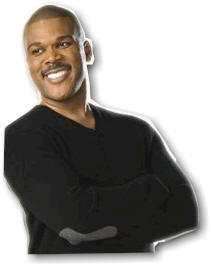
Born in New Orleans on September 13, 1969, Tyler Perry’s is a true rags-to-riches story. He overcame a troubled childhood during which he had to endure the endless abuse of his own father. In 1992, inspired by Oprah Winfrey, Tyler started writing some soul-searching letters to himself as a catharsis for his pain. These journal entries, in turn, would ultimately serve as the basis for his first play, entitled I Know I've Been Changed.
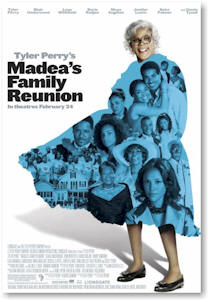
The 6’5’ actor/writer/director's success with that hit musical would change the face of urban theater, enabling him to tour the country with his company in a string of sellout performances of that and Woman, Thou Art Loosed, Behind Closed Doors, and I Can Do Bad All by Myself. A year ago, he parlayed his most popular character, Madea, into a major motion picture via the big screen version of Diary of a Mad Black Woman. Here, he talks about his return for another round in drag as the sassy, 68 year-old senior citizen in Madea's Family Reunion.
The Madea's Family Reunion Interview with Kam Williams
 Kam Williams (KW): How does all the success you're enjoying impact you, given
where you've come from having once been homeless?
Kam Williams (KW): How does all the success you're enjoying impact you, given
where you've come from having once been homeless?
Tyler Perry (TP): What it does is it completely makes me grateful, totally. I'm really so grateful for all this stuff that happens. Whenever I think of any of the other stuff I'm hearing, the good or the bad, which tries to take me away from the gratitude, I always remember to get back to the base of the gratitude and to thank God for it. I thank God for it everyday. I really do.
KW: In Madea's Family Reunion, like Diary of a Mad Black Woman, you tackle the serious issue of the abuse of women. Is it a burden trying to deal with such a serious subject while making a comedy?
TP: I try not to take on the weight or the burden of it. Once it's on the paper, I try to leave it, because I want to surrender to what I'm supposed to write about. I'm supposed to write about this character, how she overcomes, and completely just let that go, after I do that. But I think a part of me, at some point, remembers the little boy that I was, and watching my mother go through a lot of things, and hopes that some other child's mother will see this and go, ’You know what? My kid is watching this.’ And maybe that will make them better. I do get that kind of letter, and those are priceless for me.
KW: How did life change for you following the release of Diary of a Mad Black Woman at this same time a year ago?
TP: I was still working. I stayed on tour all the way until June, so I didn't feel any of what was happening. I just knew when I got back to Atlanta and tried to go to the mall, something had changed. Before, I could always go to the mall, and a few people might recognize me and stop me, but after that, there was a lot of pointing and stuff, and I realized I had worked my way completely through it.
KW: So, where are you living now?
TP: It's in Atlanta. It's an actual plantation. There were 150 slaves living on it at one time. It's called the Gaither Plantation.
KW: Are you concerned that Madea's spanking a kid in this movie might be controversial?
TP: I wrestled with that. I asked myself, ’Do I take this out? She's spanking a foster child, of all children.’
KW: How did you resolve it?
TP: You know what I did when I found myself wrestling with it? I asked 30,000 people a week, at the end of the stage show. I said, ’Listen, there's a scene in here where I'm spanking this kid. What do you think? Should I leave it in?’ They went, ’Yes! Yes! Yes!’ So, I went with the people on it.
KW: To what do you credit your uncanny ability to tap into something that resonates emotionally with so many people?
TP: I totally give credit to God for all of this stuff, because if I had tried to make these things happen, I couldn't have. To have all these things happen has been absolutely amazing. The road that I'm on is a path that I didn't choose. It chose me. I'm just trying to walk it, and to do the best that I can to honor and respect it.
KW: What's involved in your creative process as a writer? Do you squirrel yourself away from the world and then start recalling experiences from childhood?
TP: No, I don't, because a lot of times what happens is, I'll write something, and my sister or somebody will see it and they’ll go, ’Do you remember when that happened? That's probably where you got that from.’ And I go, ’Wow! You know what? you're right.’ Because once I forgave a lot of things from my past, I really have forgotten a lot of them.
KW: How important was it to you to have Maya Angelou and Cicely Tyson participating in this project?
TP: It was extremely important because I speak across generations, and I thought this was a great opportunity to introduce Dr. Angelou and Ms. Tyson to a whole younger generation of children who may not even know who they are, but they know Madea. So, I just think it was a wonderful thing.
KW: Why did you decide to direct Madea's Family Reunion yourself? Afterall, you let someone else direct Diary of a Mad Black Woman.
TP: Because I know the story and the character, and when I tried that with Diary it kept coming back to me. The more I tried to throw it out, it kept coming back to me like a boomerang. All the questions kept coming back to me. "Why is this like this?" Since I had all the answers, this time I decided to save the headache and just direct it.
KW: Who inspires you?
TP: Overall, the person on Earth would be the legacy of Oprah, and what she's done. Both her great business sense, and what she's tried to represent.
KW: Thanks a lot for the interview.
TP: Thank you, take care.
Related Links
Tyler Perry The “Madea’s Witness Protection” Interview (June 2012)
Tyler Perry - The "Good Deeds" Interview
Related LinksTyler Perry - The Family That Preys Interview
The Family That Preys - Film Review
Sanaa Lathan: The Family That Preys Interview
Taraji P. Henson: The Family That Preys Interview
Tyler Perry - The Madea's Family Reunion Interview
Why Did I Get Married? - Film Review
Blacktrospective 2007 Annual Look Back at the Best (and Worst) in Black Cinema
