|
Cornel West: The Hope on a Tightrope Interview
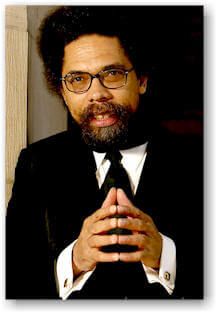
KW: Hey, Dr. West, thanks for the time. A mutual friend, Ila Forster, asked me to say hello for her. She was an undergrad when you were a grad student at Princeton. She says that back in the day you would come to parties on campus dressed in a black vest, black slacks, and a white shirt, which is still your uniform. She told me, 'The brother has not changed...and that is why I respect him. He's an intellectual but a down brother just the same.' That has me wondering why you always wear a three-piece suit.
CW: Wow! Well, first I want to say hello to the dear sister. We go back years, but my memories of her are quite fresh. Send her my best regards. Secondly, as far as my wardrobe, my role models are jazz musicians and black preachers. The suit connotes a kind of elegance and commitment to excellence, as well as a seriousness of purpose in your chosen vocation. It also connects to a sense of having a cheery disposition but a sad soul due to the mourning of catching hell because of the bigotry and oppression operating in this nation. So, it's a uniform on the battlefield. KW: What is your general impression of Princeton students and what do you enjoy about teaching Princeton students, in particular? CW: Princeton students are, in a way, similar to Harvard students. They work hard. They're highly disciplined and very intelligent. They spend a great deal of time trying to read and write well. It's a joy just being in conversation with them. It keeps me young and keeps me humble. KW: I write an annual 10 Best and 10 Worst Black Books List. Ironically, back in 2006, a book to which you contributed, The Covenant, made my 10 best List, while I named The Audacity of Hope the worst book of the year. This was before Obama had declared himself a candidate. I indicted it as the transparent attempt of a guileful politician to be all things to all people. CW: That's what it is. Strategic and tactical, all the way down. It's speaking less to the truth as regards to the election, which is to say white moderates, the folks he was appealing to for most of the campaign, because he figured he had black folks in his back pocket, which he did. And we did push him over the top. But the truth still has got to rise sooner or later. KW: What troubled me most during the campaign was how he threw Reverend Wright under the bus after that historic speech in Philadelphia about how he couldn't abandon him any more than his white grandmother. Since I agreed with much of what Reverend Wright had to say, that had me wondering whether Obama would even want my endorsement, if I were famous, or that of any celebrity who shared my left of center leanings. CW: Well, that was the fear of my close partners, including brother Tavis [Smiley]. I was with Obama from Iowa, from the very beginning. I spoke twice on his behalf back then. But in the middle of the campaign I also spoke at Jeremiah Wright's retirement, and defended him in his church. I asked what was wrong with his saying Goddamn a nation that had killed innocent people. There's nothing controversial about that whatsoever. It was interesting because the Obama surrogates had to be OK'd by the national headquarters in Chicago. And they said 'no' to most of the black folks who were suggested. Yet, when my name came up to speak in Ohio, they said 'yes,' according to one black brother who was on staff there. He was surprised, after all the stuff he'd heard me saying. When he asked why I'd been approved, they told him, 'We really believe, that, deep down, brother West really loves Obama. He just speaks his mind. And when he speaks his mind, he actually brings more people.' And, of course, they're interested in votes. 'He brings more credibility, even though Barack knows he's going to be critiqued when brother West's there. But he's also going to get his support because he criticizes in such a way that he's not going to be trashing our candidate, because he really loves him.' And sho' nuff, I was invited to Ohio in October by the campaign, whereas there were a number of other folks they rejected, including some members of the Congressional Black Caucus. KW: Why were they rejected, because they had supported Hillary in the primaries? CW: Yes, and because they thought they couldn't bring big enough crowds, and they didn't think they would speak with enough passion. They didn't just want technocrats out there and have only 75 people show up. They wanted somebody who speaks with passion who was going to connect. That's the only way you get people to the polls. KW: What do you think of Obama's appointments of Hillary and so many folks from the Clinton administration? CW: We now live in the Age of Obama. It's such a profoundly overwhelming and in some ways unprecedented moment. I fear that my dear brother Obama might be reluctant to step into his own age. So, he's falling back on them and recycling them to have some sense of connection to what was before and for their savvy and experience. But I think the crisis is so deep that we're going to need a much deeper break from the Age of Ronald Reagan. It is understandable that Obama would be hesitant to step into his own age, because if he makes his own break he could be accused of bringing in radicals or inexperienced people. He thinks he needs to make the Establishment feel comfortable. Consequently, the Establishment's crazy about all the people he's picked so far. KW: Even the Republicans. And that's scary to me. CW: Absolutely! That's very scary. That would make me have grounds for suspicion. However, I do want to give him time. If he really does aspire to what I believe and hope he aspires to, namely, to be a progressive Lincoln, then we have to be like Frederick Douglass to help push him. If he has his own vision, then he could use these folks to push it through. But he has to be bold enough, strong enough and visionary enough to step into his own Age. When he chose Rahm Emmanuel as his Chief of Staff, I wasn't excited at all. But I do want to give him time, because Emmanuel is such a bulldog maybe he can push progressive legislation through, the way he pushed through NAFTA and the Welfare bill, both of which were disasters for the working people and poor people. So, I'm just being honest about our skepticism. KW: What do you think about Obama's tapping Larry Summers, another former Clintonista? When he was president of Harvard, his racism and sexism led to a mass exodus of professors, including you. CW: Summers, we know, is just socially challenged. He cannot treat certain people with decency and empathy, and I'm one of them. I don't like the fact that he could be so explicitly sexist, and that he could trash the black man, and yet all that baggage can now be brushed aside as if it's completely irrelevant. There's a double-standard here, because when it comes to considering prominent black figures who constitute any kind of threat to the white mainstream, they're dropped like a hot potato. Politically, my critique of Summers is the same as my critique of Robert Rubin, Timothy Geithner and Jason Furman. They're all deregulators who helped contribute to the catastrophe. And now, all of a sudden, they're supposed to come to the rescue. KW: Why hasn't he tapped some of the brilliant, progressive economists who aren't Clintonistas or already part of the corporatocracy? CW: I was on the radio calling for folks like William Greider, Paul Krugman, James Galbraith, William Julius Wilson, Sylvia Ann Hewlett and Joseph Stieglitz. All these are progressive economists. Nobel Prize-winner Paul Krugman, my dear brother and colleague at Princeton, is very important. Of course, the Obama people won't touch him with a ten-foot pole yet. They will eventually. I think Brother Obama is wise enough to be pushed by events, even if he's not going to be pushed by his advisors. Those folks are a little too anemic. KW: I have a question for you from Reverend Florine Thompson who asks, 'What are three key ways in which President-elect Obama can, as you say, move from symbol to substance? And how does Black America hold him accountable?' CW: Well, for one, I think he's already made a move towards substance in terms of his stimulus packages. He's putting a focus on the financial Katrina and the two million distressed homeowners. He's dispersing funds directly to them. Plus, he's planning public spending on job creation. And those same people need healthcare independent of their employment, because they're going under. I'm glad that he's letting us know that that is the first order of business. This is crucial, because everyday people on the ground level aren't benefiting at all from Treasury Secretary Paulson's recapitalization of the banks. A second key is for him to let the world know that America is not going to be behaving unilaterally like a policeman, but cooperating with other countries and the United Nations to achieve a multilateral vision. It's important that we have a different public face, one that is not consistent with dominating and manipulating, but with listening to the rest of the world. The third key I'd like to see Obama focus on is the plight of children, and to say, 'We're going to wipe out child poverty,' because they are our future, 100%. KW: Reverend Thompson also asks, 'How should President elect Obama deal with affirmative action in the 21st century? And have you noticed a racial backlash since Barack Obama won the presidential election?' CW: Well, there is definitely a white backlash, and I'm sure it's escalating. The good thing is that those racists don't speak on behalf of the vast majority of whites. That's a sign of progress. Of course, the press calls it post-racial. It's not post-racial, just less racist. KW: Since the election of Barack Obama, it's been said from the pulpit of many black churches that African-Americans are now without excuse regarding their lack of responsibility, high school drop-outs, high crime, illegal drug usage, and other social ills. Reverend Thompson wonders whether you find any truth to this statement. CW: Not at all. It's just right-wing jargon which suggests that somehow we've never wanted to be responsible. And those folks who haven't been responsible, should have been. They didn't need to wait for Obama to win. The greatest critics in terms of black responsibility has always been the black community itself. So, I think we've always had black responsibility. One election doesn't make a difference in that regard. Besides, a black face in the White House doesn't mean that the fight against racism is over. There's still white supremacy, police brutality, and discrimination in the workplace, in housing and so forth to deal with. KW: Some have said that President-elect Obama was "God's candidate" and that he was divinely appointed. Do you believe that? CW: I don't think God is in the business of selecting candidates. God is a God of justice. All of us stand under divine judgment. So does Barack. Where Barack is on the side of justice, God is for him. Where Barack is lukewarm towards justice, God is suspicious. And where he's against justice, God is critical. That's true for all of us. KW: Anthony Noel, a Muslim brother says, 'You, as a person of faith, have made it a point to criticize those of us who condemn homosexuality and its behavior, as being homophobic. What is your basis for such a criticism?' CW: As a Christian, I'm Christ-centric, and Jesus did talk about the quality of love and the quality of relations, and I think that it is possible for there to be mature love between same-sex brothers and sisters. KW: Tony also asks, what is your impression, thus far, of Obama's appointing so few blacks to positions in his administration? CW: Give him time, but their color is not as important as what they stand for. KW: Yeah, look at Clarence Thomas. CW: Exactly! KW: And Tony asks, does Obama's support of Planned Parenthood, an abortion advocacy group, in your view, put him in contradiction to his claims of being a person of faith. CW: No. KW: Marianne Ilaw asks whether you think that Obama is more palatable to whites because he doesn't carry the legacy of slavery and all its uncomfortable baggage, and whether his election will usher in a new era where whites opt for exotic-looking blacks, African and Caribbean immigrants and biracials, over those folks whose ancestors toiled in the fields? CW: No, Obama is a gentle brother with a sweet disposition that doesn't constitute a threat to white brothers and sisters. Malcolm X was full of rage and righteous indignation. I'm with him, too. I love all different kind of black folks. Malcolm X was a different type of black man from Obama. That doesn't mean Barack is not honorable. We can appreciate them both. KW: The Columbus Short question: Are you happy? CW: I do have a joy in my soul for my faith, and friends and family. KW: The Tasha Smith question: Are you ever afraid? CW: Sure. KW: The bookworm Troy Johnson question: What was the last book you read?
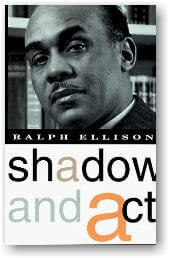
CW: Shadow and Act by Ralph Ellison. I read all 330 pages of it last night. KW: Is there any question no one ever asks you, that you wish someone would? CW: No. KW: The music maven Heather Covington question: What's music are you listening to nowadays? CW: Thelonious Monk. KW: My mom grew up with Monk and was lifelong friends with his sister. During my brief stint as a jazz musician back in the Seventies, I played on an album with Bob Northern, aka Brother Ahh, who had played with Monk in the Fifties. Also in our group was saxophonist Pat Patrick who is the father of Deval Patrick, the Governor of Massachusetts. CW: I didn't know Deval's father played. KW: Yeah, Pat Patrick's a giant. He played baritone with Sun Ra for years. He was the cat with the dark glasses. He also played with Monk, Coltrane and Duke Ellington. CW: Is that Deval's father? Wow! KW: Yep, well, thanks again for the interview and I hope to chat with you again soon about your memoirs which I understand you'll be publishing next year. CW: Thank you. You're welcome to come right on in anytime.
Related Links
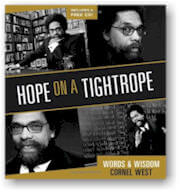
Review of Dr. West's book Hope on a Tightrope: Words and Wisdom
Dr. Cornel West - The ’America’s Next Chapter’ Interview
Cornel West - The 'Brother West' Interview
AALBC.com Author
Profile for Cornel West
|